In the fertilizer production process, from raw material feeding, crushing, and screening to packaging, dust is generated in almost every step. This seemingly insignificant dust not only represents a direct loss of valuable raw materials but also poses a significant risk to the working environment, employee health, and potential environmental penalties. Especially in today’s increasingly stringent environmental regulations and the growing consensus on green manufacturing, an efficient and reliable dust collection system is no longer an “optional configuration,” but a core component of “environmentally friendly fertilizer equipment” that any responsible fertilizer production enterprise pursuing sustainable development must invest in.
The Harm of Dust: Costs and Risks Far Beyond Imagination
The negative impacts of inadequate dust control in fertilizer production are multifaceted. First, it represents a direct economic loss. Taking a compound fertilizer production line with an annual output of 100,000 tons as an example, if the dust emission rate is not controlled, the annual loss of raw materials can reach hundreds or even thousands of tons, meaning that real profits are literally blown away. Secondly, it poses a serious safety and health threat. The dust pervasive in the workshop not only damages employees’ respiratory systems, but high concentrations of fertilizer dust also pose an explosion risk under certain conditions. Finally, it represents the most direct risk of environmental violations. Uncontrolled dust emissions are a key focus of environmental inspections, and once exceeding the limits, companies face production shutdowns, hefty fines, and severe damage to their reputation.
Therefore, investing in dust control is essentially paying a certain and controllable cost to avoid uncertain but potentially huge operational risks, while simultaneously improving production efficiency and resource utilization.
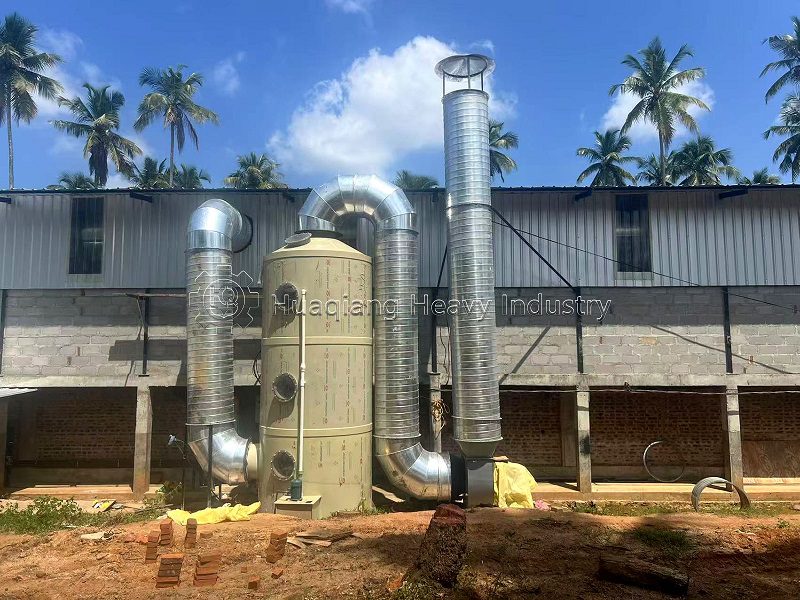
Core Technology: Solutions Centered on “Pulse Jet Dust Collection Systems”
Among numerous dust control technologies, the pulse jet bag filter dust collection system has become the mainstream choice for modern fertilizer production lines due to its high efficiency, stability, and adaptability. The working principle of this system is not complex, but the design is ingenious: the dust-laden airflow enters the dust collector under the suction of a fan. When passing through the filter bags made of special filter materials (such as anti-static polyester needle felt), the dust is blocked on the outer surface of the filter bags, and the purified air is discharged from the inside of the filter bags. As dust accumulates on the outside of the filter bags, the system uses periodic compressed air pulses to back-flush the bags from the inside, dislodging the caked dust into the hopper below. This achieves automatic cleaning of the filter bags and ensures continuous and efficient operation of the system.
The advantage of this system is that its dust removal efficiency can easily and stably reach over 99.5%, and it is extremely effective in capturing dust particles larger than 1 micrometer. Its modular design also allows for flexible configuration based on the specific dust generation points of the production line (such as feeding ports, crusher outlets, screening machines, and packaging machines), forming a comprehensive dust collection network covering the entire process.

Key Application Points: Comprehensive Protection from Source to End
A complete “fertilizer production dust control” system requires targeted design at the following key dust generation points:
Feeding and Crushing Sections: This is the section with the largest amount of dust and the coarsest dust particles. It is recommended to install a semi-enclosed dust collection hood above the feeding port and connect it to a high-volume pulse dust collector to “capture” the dust as soon as it is generated, preventing its diffusion.
Screening and Lifting Transfer Points: Dust is easily stirred up at the inlet and outlet of vibrating screens and at material drop points such as the head and tail of bucket elevators. Installing soft curtain enclosures at these points and connecting them to dust collection ducts can effectively control secondary dust generation.
Packaging Section: The packaging machine is the last checkpoint before the product leaves the factory and is also the “face” of dust control. Using an automatic packaging scale with a built-in dust collection system can simultaneously suck away airborne dust during the filling process, ensuring a clean workshop and accurate product net weight.
These devices together form a three-dimensional dust barrier from source to end, firmly locking the dust within the production line.
Beyond Compliance: The Strategic Value of Dust Control
Investing in advanced dust control equipment means far more than simply “compliance.” It brings strategic value to the enterprise. Firstly, it achieves closed-loop resource utilization. The collected dust is not waste, but rather raw material that can be returned to the granulation process, directly reducing production costs. Secondly, it shapes the image of a modern factory. A clean, dust-free production environment not only boosts employee morale and sense of belonging, but also serves as a silent testament to the company’s professional management standards and social responsibility to customers, partners, and regulatory authorities. Thirdly, it paves the way for future development. With the advancement of “dual carbon” goals and ultra-low emission requirements, companies that proactively establish high-standard environmental protection facilities will gain a significant advantage in future market competition and policy adaptation.
A comprehensive dust collection system is a critical component of modern professional fertilizer manufacturing equipment, integrated into the entire fertilizer raw material processing machinery and equipment suite. Whether for a conventional npk fertilizer production line (utilizing an npk blending machine for formulation and a disc granulator or double roller press granulator for shaping) or a bio organic fertilizer production line (starting with a windrow composting machine for fermentation), dust is generated at key stages like crushing, mixing, and packaging. An efficient pulse jet dust collection system is thus seamlessly integrated into the complete npk fertilizer line, capturing valuable raw material particles, ensuring a safe working environment, and maintaining regulatory compliance, thereby protecting both the investment and the operational continuity of the fertilizer plant.