Tag: drum fertilizer cooler

Drying and cooling: The core of quality assurance in fertilizer granule post-processing

Fertilizer granules after granulation often suffer from problems such as high moisture content, high temperature, and low strength, making them unsuitable for direct storage and transportation. In the post-processing stage of organic fertilizer production lines, the coordinated operation of dryers and coolers is crucial to solving these problems. They form a complete chain of “dehydration and shaping – cooling and strengthening,” directly determining the final quality of the fertilizer granules.

The drum fertilizer dryer undertakes the core task of “dehydration and shaping.” Granules fresh from the fertilizer granulator usually have a moisture content of 20%-30%, and need to be sent to the dryer to complete the drying process through a hot air circulation system: high-temperature hot air (60-80℃, adapted to the characteristics of organic fertilizer) fully contacts the granules, and with the help of internal baffles, ensures that each granule is evenly dehydrated, ultimately controlling the moisture content within the safe range of 12%-14%.
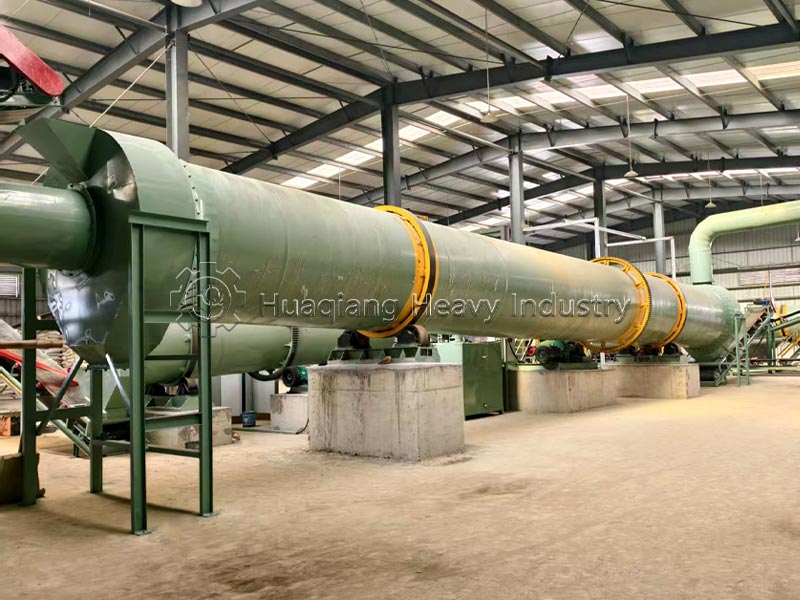
The drum fertilizer cooler connects the critical “cooling and strengthening” stage. The temperature of the dried granules can reach 60-80℃. If directly piled up, they are prone to re-moisturizing and clumping, and may even break due to thermal expansion and contraction. The cooler uses the principle of cold air heat exchange to quickly cool the high-temperature granules to near ambient temperature (temperature difference ≤5℃), and at the same time further tightens the granule structure during the cooling process, significantly improving the strength and hardness of the granules.

The core advantage of their combined operation lies in “process+quality complementarity.” During operation, it is necessary to match the capacities of the two machines, adjust the drying temperature and cooling air speed according to the granule size and raw material characteristics, and regularly clean the accumulated material inside the equipment to ensure smooth ventilation. As the “golden partners” in the post-processing of organic fertilizer production lines, their coordinated operation can increase the qualified rate of fertilizer granules to over 95%.
Grasping the key to effective drying! How organic fertilizer dryers protect fertilizer quality?

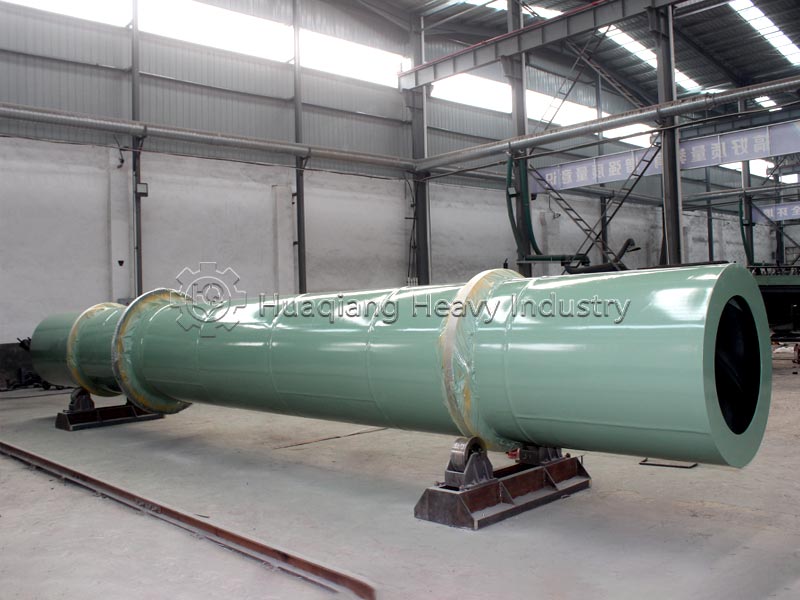
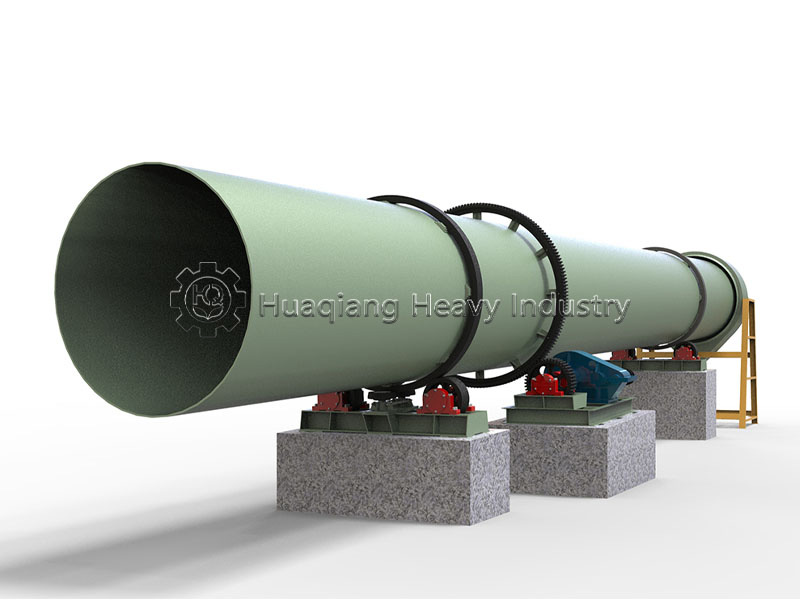
The drying process is the crucial final step in determining the quality of organic fertilizer. Common quality problems such as excessive moisture, nutrient loss, and particle damage are often related to inadequate drying. As a core piece of equipment in the subsequent processing, the drum fertilizer dryer, through its core functions of scientific temperature control and uniform drying, can precisely address these quality issues.

Addressing the problem of “excessive moisture leading to mold”: The dryer uses layered temperature control technology to precisely reduce the material moisture content to a safe standard of 12%-14%. It employs a hot air circulation drying mode, allowing the hot, humid airflow to fully contact the material, quickly removing excess moisture and preventing mold and clumping caused by incomplete drying in certain areas. This extends the shelf life of the organic fertilizer and ensures stability during storage and transportation.

Solving the problem of “high temperatures causing nutrient loss”: High-quality dryers have the capability of low-temperature, high-airflow drying, controlling the drying temperature within a reasonable range of 60-80℃. This temperature efficiently removes water while preventing the decomposition and loss of core nutrients such as organic matter, nitrogen, phosphorus, and potassium in the organic fertilizer due to high temperatures, ensuring that the finished product’s fertilizer efficiency is not compromised.

Addressing the problem of “uneven drying leading to particle damage”: The internal baffle structure of the dryer ensures uniform turning of the material, allowing every particle to come into contact with the hot air, preventing particle deformation and damage caused by local overheating or incomplete drying. At the same time, the dried material is rapidly cooled by a matching drum fertilizer cooler, further improving particle strength and reducing powdering loss during subsequent screening and packaging.

It should be noted that the effectiveness of the dryer depends on proper operation. As a key piece of equipment in the organic fertilizer production line, the precise drying function of the dryer not only improves the finished product’s qualification rate but also enhances the market competitiveness of the organic fertilizer.

The drum fertilizer cooler is a key piece of equipment in fertilizer production lines

In modern fertilizer production systems, the application of drum fertilizer coolers is no longer limited to traditional organic fertilizer production lines. Whether processing compound fertilizer granules on NPK blending fertilizer production lines or organic materials in bio-organic fertilizer equipment systems, this equipment demonstrates excellent adaptability and stability.

Structurally, the drum fertilizer cooler achieves full contact between the material and cooling air through a slowly rotating cylinder and an innovative internal airflow guiding device. This design is suitable not only for conventional organic fertilizer production but also meets the stringent cooling requirements of NPK blending fertilizer production lines. After the material is mixed and granulated in the NPK blending machine, it enters the drum cooling system for rapid cooling, ensuring stability during subsequent packaging and storage.

In bio-organic fertilizer equipment systems, the drum fertilizer cooler plays an even more crucial role. Because bio-organic fertilizers contain active microbial components, excessively high temperatures can affect the activity of the microbial community. The drum fertilizer cooler, through a precise temperature control system, can effectively protect the beneficial microorganisms in the fertilizer while rapidly cooling it, ensuring the application effect of the bio-fertilizer.

It is worth mentioning that modern drum fertilizer coolers also excel in energy conservation and environmental protection. Whether in NPK blending fertilizer production lines or bio-organic fertilizer equipment systems, their optimized air duct design and heat recovery devices can effectively reduce energy consumption while ensuring that the production environment meets environmental protection standards.

Drum fertilizer cooler selection: Consider key dimensions and avoid common mistakes

Choosing the right drum fertilizer cooler not only ensures effective material cooling but also reduces subsequent operating costs. However, when selecting a drum fertilizer cooler, it’s easy to fall into the trap of focusing solely on throughput, overlooking key factors like material properties and operating requirements.

First, clarifying the material properties is essential. Differences in moisture, particle size, and viscosity between materials directly impact cooling performance. For example, high-humidity materials tend to adhere to the drum’s inner walls, so a model with internal scrapers or special liners should be selected to prevent material accumulation. For fine powders, sealing performance is crucial to prevent dust leakage during cooling, requiring efficient, sealed feed and discharge devices. Ignoring material properties can lead to uneven cooling and equipment blockage, even if the throughput is appropriate.

Second, determine the cooling method based on cooling requirements. If the material needs to be cooled quickly and has no special requirements for the cooling medium, forced air cooling can be chosen to improve cooling efficiency by increasing air volume. If the material temperature is extremely high (over 600°C) or needs to be protected from air contact, jacket cooling is preferred. This uses thermal oil or cold water for indirect cooling, minimizing material contact with the outside world.

Finally, drum fertilizer cooler parameters should be tailored to the operating conditions. Consider the workshop space (determining drum length and diameter), power supply voltage (matching drive motor parameters), and ease of maintenance (ease of disassembly and cleaning). For example, if workshop height is limited, a horizontally arranged short-drum machine may be appropriate. If continuous production is essential, a machine with fault alarms and automatic cleaning features should be selected to minimize downtime for maintenance.

Back To Top